
Blog
Temporary Roof Patch: What Works, What Fails, and When to Call
- BBB A+
- Owens Corning Preferred
- EPA Lead-Safe
- EIFS Certified
- Licensed & Bonded
Temporary Roof Patch: What Works, What Fails, and When to Call

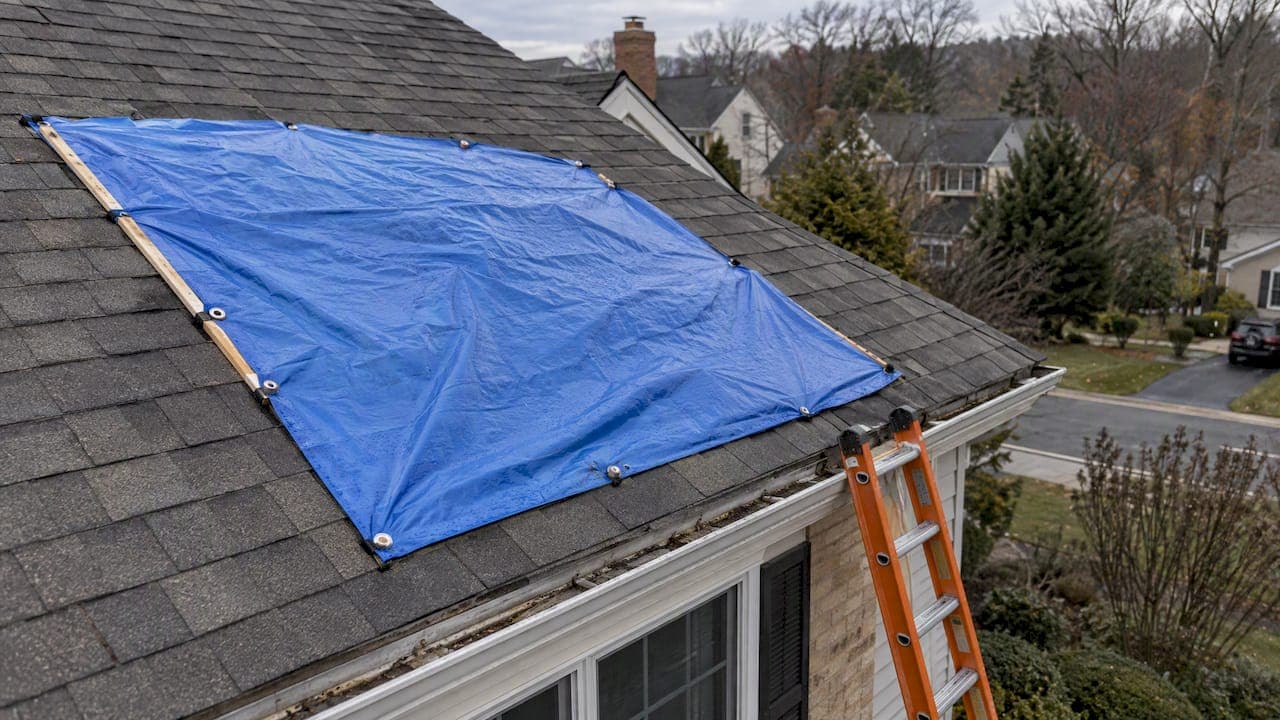
A temporary roof patch keeps water out for days or weeks, not years. It is a bridge between the moment a leak shows up and the day a roofer makes a real repair. Done well, it limits ceiling, insulation and framing damage. Done badly, it hides the problem, traps moisture or puts you in the emergency room. This guide covers what to do first, which materials suit which roof, how to apply a patch without taking foolish risks, and the signs that tell you to stop and call a professional.
TL;DR
- A patch is short-term. Tarps cover large damaged areas, while flashing or roofing cement can block small punctures and cracks, per This Old House.
- Never go on a wet, windy or tarped roof. OSHA calls tarped roofs extremely slippery when wet.
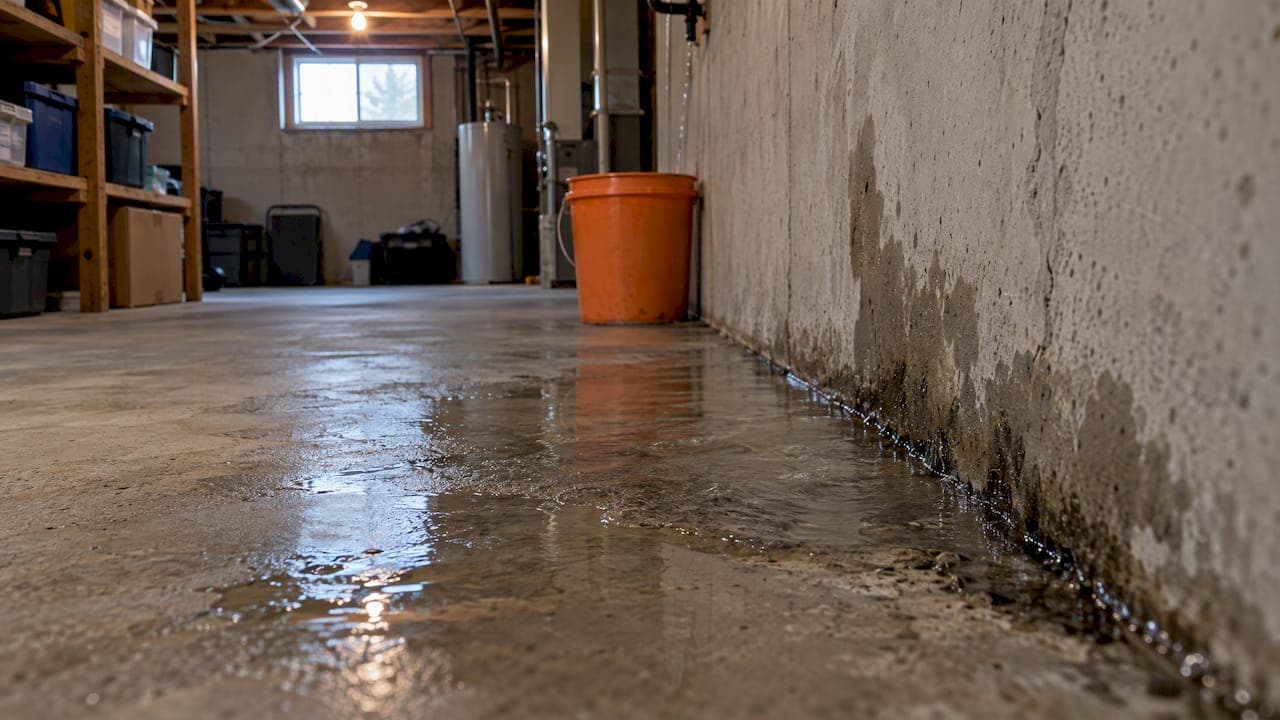
- Inside the house, catch the water, move belongings and photograph everything before you do anything else.
- Even a good patch needs a professional inspection afterward, because hidden damage under shingles and flashing is easy to miss.
Table of Contents
- What a temporary roof patch can and cannot do
- Before you climb: safety comes first
- Stop the damage inside first
- Choosing a material for your roof and your damage
- How to apply a small patch, step by step
- Does Flex Seal work on a roof leak?
- How long will a temporary patch last?
- Signs the patch is not enough
- What a temporary repair costs, and what a real one costs
- Our perspective: patch it, then prove it
- When you need a crew tonight
- FAQ
- Sources
What a temporary roof patch can and cannot do
A patch reduces the water getting in through one spot. It does not restore the roof’s design. Shingles shed water because they overlap in a pattern, with flashing sealing the joints at chimneys, walls, vents and valleys. A patch sits on top of that system and depends on the materials around it being sound.
That matters because leaks rarely sit where the stain appears. A university extension guide on leaky roofs points out that the source is seldom directly above the water spot on the ceiling. Water travels along rafters, decking and insulation before it drips. So a patch placed over the stain often misses the actual entry point.
A patch works best when:
- The damage is small and obvious: a missing shingle, a nail pop, a small puncture or a split in flashing.
- The roof surface around it is dry, clean and firm.
- You can reach the area safely, or a crew can.
- A permanent repair is already scheduled.
It fails when the decking is soft, when damage spans a slope, or when you apply sealant across a wide area hoping it will act like a new roof.
Before you climb: safety comes first
Most roof-patch injuries happen before the patch goes on. The extension guide recommends starting with binoculars for a closer look from the ground, and says only a physically able person should get on the roof for emergency measures. It also warns that roof inspection and repair can cause serious injury.
Some ground rules:
- Wait for the storm to pass. OSHA advises never installing a tarp during a storm while it is windy or raining, and never walking on a tarped roof because it is extremely slippery when wet (OSHA roof tarping safety).
- Set the ladder correctly. OSHA’s guidance is a 4:1 ratio, meaning one foot out from the wall at the base for every four feet of height, with the ladder extending at least three feet above the roof edge.
- Do not go alone. Roofing industry guidance on post-storm inspection notes you may be climbing onto a structure that is not sound, and says not to inspect alone (NRCA).
- Look for power lines and sagging. A visibly sagging section, exposed decking or a branch resting on the roof is a job for a crew, not a homeowner.
- Skip steep slopes. If you would hesitate to walk it on a dry day, do not walk it with a tube of sealant.
Professionals follow the same discipline with their gear. Ladders, harnesses and tools need regular checks, and OSHA equipment inspection requirements explain how service businesses track that. It is a fair question to ask any contractor you hire to work on your roof.
The most useful safety decision is often to stay on the ground and call for emergency tarping.
Stop the damage inside first
Whatever happens on the roof, the interior comes first, and you can do it safely from the floor.
- Move furniture, electronics and valuables away from the leak.
- Put a bucket or tub under the drip. Poke a small hole in a bulging ceiling stain to drain trapped water into a bucket only if you can do so from a safe position, away from light fixtures.
- Photograph and write notes on the damage. State Farm lists documenting with notes and pictures among the first steps, along with contacting a contractor.
- Start drying. The EPA’s mold guidance says damp or wet building materials and furnishings should be removed, cleaned or dried within 24 to 48 hours to prevent mold growth (EPA).
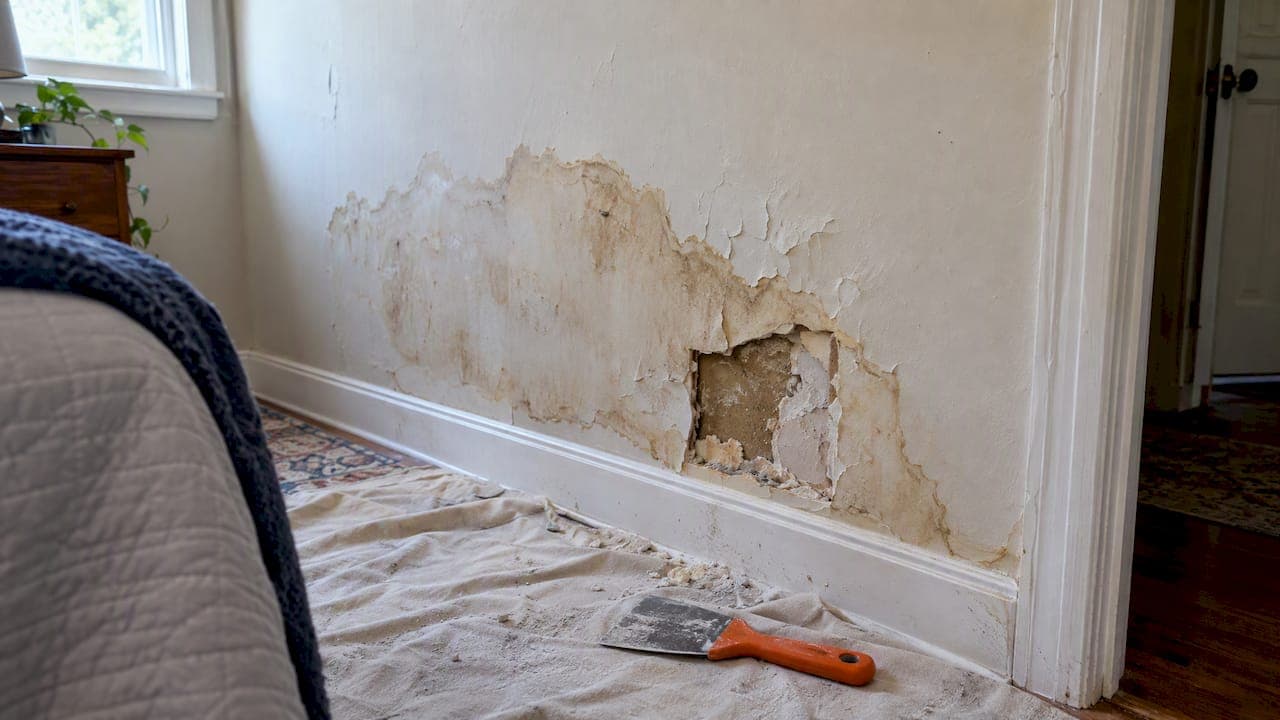
Wet drywall and insulation are the usual hidden cost of a slow leak. Our guide to roof leak and ceiling repair explains why stopping the source comes before any ceiling work, and drywall water damage repair helps you decide whether a stained ceiling can be saved.
Choosing a material for your roof and your damage
No single product fits every roof. Match the material to the size of the damage and the surface underneath.
| Situation | Typical temporary fix | Watch out for |
|---|---|---|
| Large area open or damaged by a fallen limb or wind | Reinforced tarp, secured with wood strips | Tarps must be fastened correctly, and installing one is dangerous work |
| Missing shingles on an asphalt roof | Tarp, or a replacement shingle slid into place where possible | Hidden damage to the courses around it |
| Small puncture or crack | Roofing cement or tin flashing | Cement cracks over time; do not smear it over broad areas |
| Pipe boot or flashing gap | Roofing sealant on a clean, dry joint | Old flashing may be failing for a reason |
| Flat or low-slope roof seam | Compatible patch or sealant designed for that membrane | Wrong product can fail to bond or harm the membrane |
The tarp row has support: reinforced plastic tarps, known as “Blue Roofs,” are the standard temporary protection after severe weather, according to OSHA. Older extension guidance also mentions boards, plastic sheeting and wood strips as stopgaps (extension guide). For smaller damage, This Old House describes tin flashing or roofing cement for small punctures and cracks.
One caution on cement: a manufacturer technical FAQ says black asphalt and wet-patch repairs around flashing usually fail within the first year, because expansion and contraction in temperature swings cause cracking (manufacturer FAQ). It recommends clean preparation and overlap around the repair. That fits what we see in Maryland, where freeze and thaw cycles work on every joint.

How to apply a small patch, step by step
This applies to a small, reachable problem on a pitched roof in dry, calm weather. If any part feels unsafe, skip to the next section.
- Confirm the entry point. Check the attic with a flashlight during or just after rain. Look for wet decking, dark streaks on rafters and damp insulation, then trace upslope.
- Pick a dry day. Surfaces need to be dry for most products to bond.
- Set up safely. Use a correctly angled ladder, wear soft-soled shoes and have someone on the ground.
- Clean the area. Brush away grit and loose granules.
- Apply the fix. For a cracked or nail-popped spot, work roofing cement under and around the damaged shingle edge. For a puncture, slide tin flashing under the shingle above and seal the edges. Keep sealant only where it is needed.
- Cover larger damage with a tarp. Extend it well past the damage, over the ridge if you can, and fasten it with wood strips instead of relying on adhesive alone. Honestly, this is where most homeowners should hand off to a crew.
- Check from the attic after the next rain and photograph the result.
Avoid piling on sealant. Broad coverage can hold moisture against the roof and make a later repair harder. Guidance from one contractor-oriented source also notes that incompatible products can harm some membranes or fail to bond, and that sealants should not replace permanent repairs (temporary repair materials overview).
Does Flex Seal work on a roof leak?
It can, within limits. The manufacturer states its products can seal minor roof leaks, especially as a quick or temporary fix, but are not a permanent solution for significant structural damage or full-roof repairs (Flex Seal). Its Flex Tape is described as a temporary emergency repair, not a permanent one (Flex Tape).
The directions matter more than the can. The liquid needs a clean, dry surface, multiple coats as needed, and 24 to 48 hours of drying between coats, with a full cure in 48 hours (Flex Seal Liquid). The spray calls for multiple even coats over an area larger than the leak, and up to 24 to 48 hours of curing before testing (Flex Seal Spray).

That is a problem in real life. If rain is coming tonight, a product that needs a dry surface and two days to cure is a poor fit for an active leak. And any coating over wet or dirty shingles is likely to peel. Our view: a spray or liquid is a reasonable stopgap on a dry, small, accessible problem, and a poor substitute for a tarp when the roof is open or storms are forecast.
How long will a temporary patch last?
There is no honest universal number. The manufacturer cites one customer whose tape stayed on an RV roof for two years before resealing (Flex Seal customer story), but that is one anecdote on one vehicle, not a promise for a shingle roof. Around flashing, as noted above, cement repairs often crack within a year.
What we tell homeowners is simple: plan on days to weeks, and schedule a proper repair promptly. Sun, wind, ice, thermal movement and the condition of the roof underneath all shorten a patch’s life. A tarp can protect through a rough stretch but can also be torn by wind if it is poorly secured.
Signs the patch is not enough
Call a roofer promptly if you see any of these:
- A ceiling that sags, bulges or keeps staining after you patched.
- Soft or spongy decking, or daylight visible in the attic.
- Granules collecting in gutters, curling or lifting shingles across a slope.
- Damage along roof edges and corners. NRCA notes that extreme wind damage often begins at roof edges, where suction lifts materials and repeated wind cycles can expand the damage (NRCA).
- A musty smell or visible mold. Moisture left for more than a day or two can start mold, per the EPA guidance above.
- A roof that is 10 to 20 years old and now leaking in more than one place.
This Old House advises that DIY roof repairs should be limited to the smallest, simplest issues, and that a licensed roofing contractor should inspect and repair storm damage, particularly when it is major or uncertain. It also recommends a professional inspection after temporary repairs, since hidden damage beneath shingles or flashing may not be obvious (This Old House).
Can a handyman patch a roof?
For a small, visible fix such as resealing a vent boot, many handymen can. For storm damage, unclear leaks, flashing or anything involving decking, a roofing contractor is the better call. If the work ties into an insurance claim, the documentation a roofer provides also matters.
What a temporary repair costs, and what a real one costs
A tarp or small patch is usually cheaper than a permanent repair, but pricing varies with roof height, pitch and the size of the damage. For permanent leak repair, Fixr’s January 2026 US update reports an average of $800, commonly $350 to $1,500, and $8,000 or more when decking or structural damage is involved (Fixr). Those are national figures. We do not publish set prices, because we price after an inspection and give an itemized estimate.
The expensive scenario in that range is the one where a temporary patch hid a slow leak for months. That is why we push for a prompt inspection rather than another coat of sealant.
Our perspective: patch it, then prove it
We have been on Maryland roofs for a long time. Chuck started Magnum in 2013 after close to 31 years in the trade, and the pattern is familiar. A homeowner gets a leak after a thunderstorm or nor’easter, covers it with whatever is in the garage, and the problem seems solved. Months later, we find soaked insulation and rotted decking under a neat dab of cement.
Our advice is to treat a temporary patch as a clock, not a cure. If the damage is small and you can reach it safely, patch it, photograph it and get an inspection. If the roof is open, wet or high, do not climb. Call for emergency tarping and let a trained crew secure it. Then we show you the evidence, with photos of what we found, and tell you honestly whether you need a repair or a replacement. Plenty of Towson, Lutherville-Timonium and Cockeysville roofs in the 10 to 20 year range need only a repair, and we would rather say so.
If insurance is involved, document first, tarp second, and keep the receipts. We can meet the adjuster on the roof and carry the restoration through.
— Charles Hinkel
When you need a crew tonight
If your roof is open to the weather or the leak is active, our emergency tarping service covers Towson, Baltimore City and Baltimore County. We secure the roof, document the damage, then follow with a written inspection and an itemized estimate. For the permanent fix, see our roof repair page, or reach us through Magnum Home Services. For hail, wind and storm claims, our storm and wind damage repair and insurance restoration teams work together on one job. Also see when to call for emergency roofing services and how emergency roofing prevents long-term water damage.
FAQ
What is the fastest temporary fix for a roof leak?
Inside, catch the water and move belongings. Outside, a reinforced tarp is the standard cover for larger damage, while small holes can take tin flashing or roofing cement. Do it only once the storm has passed and the roof is safe to reach, or have a contractor do it.
Does Flex Seal work on roof leaks?
The manufacturer says it can seal minor leaks as a temporary fix, not significant damage. It needs a clean, dry surface and 24 to 48 hours of curing, so it is a poor choice during active rain.
How long can a temporary roof patch last?
Plan on days to weeks. Some patches last longer, but flashing repairs with cement often crack within a year. Book a permanent repair soon after patching.
Is it safe to tarp my own roof?
Often it is not. OSHA calls tarping dangerous and advises against doing it in wind or rain or walking on a wet tarp. If the roof is steep, high or wet, call a crew.
Sources
- Assessing and Repairing Leaky Roofs, University of Wisconsin Extension
- Roof Tarping (Blue Roof) Safety, OSHA
- Mold: Worker and Employer Guide, EPA
- Leaking Roof: Here’s What to Do, State Farm
- How To Repair a Roof With Storm Damage, This Old House
- Roof Repair After a Hurricane, NRCA
- Flexible Seal technical FAQ
- Temporary roof repair materials overview
- Will Flex Seal Fix a Roof Leak?
- Flex Tape
- Flex Seal Liquid
- Flex Seal Spray
- Flex Seal product family
- Fixr roof leak repair costs
- OSHA equipment inspection requirements
Recommended
Free, no-pressure inspections across Towson & Baltimore County.
Keep Reading
More from the blog
Free Estimate
Get your free, no-pressure roof estimate
Tell us what's going on and we'll call you within one business hour. Same-week appointments available across Baltimore County.
- BBB A+
- Owens Corning Preferred
- EPA Lead-Safe
- EIFS Certified
- Licensed & Bonded