
Blog
72 Hours to Protect Your Hail Damaged Roof and Claim, Homeowners
- BBB A+
- Owens Corning Preferred
- EPA Lead-Safe
- EIFS Certified
- Licensed & Bonded
72 Hours to Protect Your Hail Damaged Roof and Claim, Homeowners

A simple size rule tells you most of what you need to know: hail under one inch, about the size of a dime, usually means only cosmetic wear, while hail between one and two inches, quarter to golf-ball size, often fractures shingles, and anything over two inches frequently causes structural damage. If a storm with hail that size hit your neighborhood, document the roof, arrange temporary protection if it is leaking, and call your insurer and a licensed contractor before you do anything else.
TL;DR:
- Hail between one and two inches in size can fracture shingles and cause structural damage, making inspection and documentation essential.
- Visual signs like granule loss, cup-shaped bruises, and dents in gutters or metal surfaces help identify hail damage, especially when patterns are random.
- Cosmetic damage, such as shallow dents or granule loss, often does not threaten the roof’s water-tightness, unlike fractures or tears that require immediate repair or replacement.
- Photographs from multiple angles with scale references and detailed collateral evidence within 72 hours significantly improve insurance claim outcomes.
- Professional inspection, proper documentation, and understanding your policy’s coverage are critical to avoid underestimating damage or facing costly repairs later.
Table of Contents
- Signs of Hail Damage on Shingles, Metal, and Tile Roofs
- Cosmetic Versus Functional Damage and Why Your Roof’s Lifespan Depends on It
- Your 72-Hour Checklist After a Hailstorm
- How Hail Insurance Claims Actually Work
- Deciding Between Roof Repair and Full Replacement
- Vetting a Roofing Contractor Without Getting Burned
- Who Is Behind This Guide
- Should You Tarp It Yourself or Call a Professional
- Why Hail Risk Looks Different Depending on Where You Live
- The Inspection Gap Most Homeowners Never Close
- Getting Your Roof Assessed and Repaired the Right Way
- Sources
- FAQ
Signs of Hail Damage on Shingles, Metal, and Tile Roofs
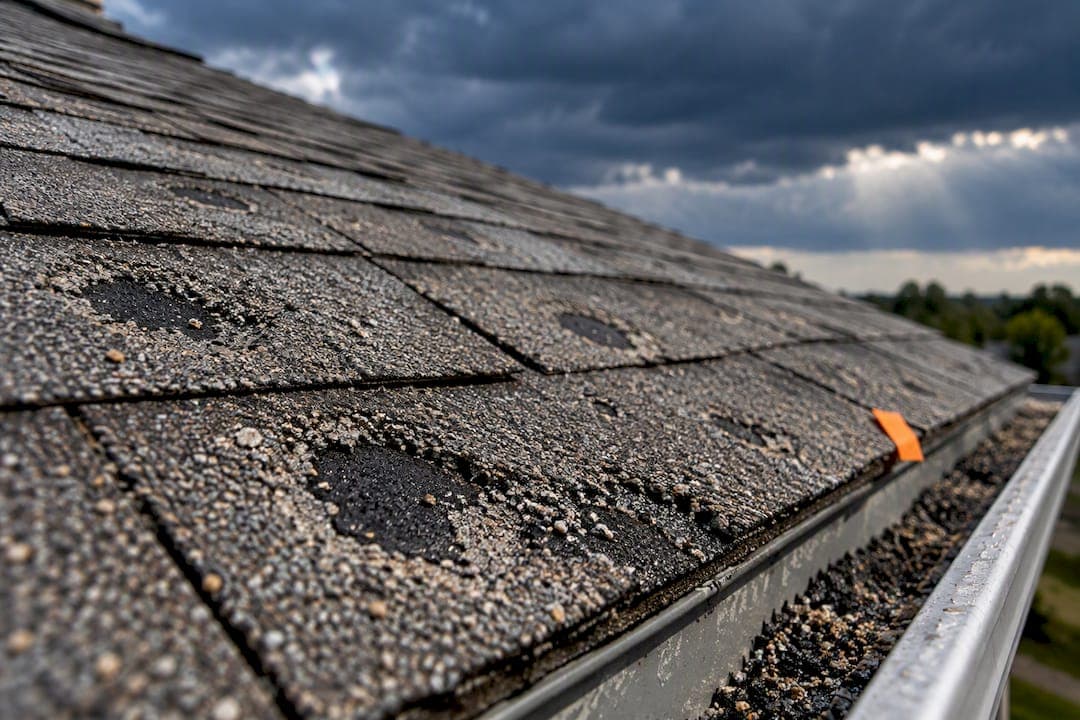
Hail leaves different marks depending on what it hits, and knowing the difference between storm damage and ordinary wear saves homeowners from either overreacting or missing a legitimate claim. On asphalt shingles, look for granule loss that leaves dark, sand-like deposits in gutters and downspouts, along with cup-shaped bruises you can often feel with your hand even when you cannot see them clearly. According to IBHS inspection guidance, genuine hail damage tends to occur in a random pattern rather than a uniform one, and ridge caps are particularly vulnerable because they sit exposed at the roof’s highest points.
Metal roofing and flashing show hail differently than shingles do. Dents in flashing, soft-metal vents, or thin gauge panels are common, and on lighter-gauge metal, hail can occasionally punch through or loosen fasteners enough to create a path for water. Tile roofs tend to crack or shatter outright, with chips concentrated at edges and corners where tiles overlap, and displaced tiles are often the first visible clue from the ground.
Collateral evidence around the property is frequently what convinces an adjuster a hail event actually occurred and how severe it was:
- Dented gutters, downspouts, or window screens in a scattered, non-uniform pattern.
- Damaged fins on an outdoor air conditioning unit, which are soft enough to show impacts clearly.
- Spatter marks or small dings on vehicles, siding, or exposed wood decking.
- Bent or pitted mailbox and fence tops, which often confirm hail size and direction.
More than half of homeowner insurance claims tied to weather involve wind and hail, according to IBHS, which is part of why documenting collateral damage matters so much for building a credible claim.
When you inspect, photograph from multiple angles and hold a coin or ruler next to any mark for scale, then compare the suspected damage to an unaffected section of the same roof slope.
| Roof type | Typical hail damage sign | Where it concentrates |
|---|---|---|
| Asphalt shingle | Granule loss, cup-shaped bruises, mat fractures | Ridges, hips, roof edges |
| Metal | Dents in flashing or vents, loosened fasteners | Flashing, soft vents, thin panels |
| Tile | Cracked or shattered tiles, edge chips | Tile edges and corners |
Cosmetic Versus Functional Damage and Why Your Roof’s Lifespan Depends on It
Not every mark left by hail threatens your roof’s ability to keep water out, and the distinction between cosmetic and functional damage is the single most important idea in this entire process. Cosmetic damage is surface-level: granule loss and shallow, non-penetrating dents that affect appearance but do not compromise the shingle’s structure. Functional damage is different in kind, not just degree. It includes cracks, fractures in the fiberglass or organic mat beneath the granules, and tears that may only be visible from the underside of the shingle.
UL 2218 impact classes are the industry standard for comparing how shingles hold up under simulated hail, using steel-ball drop tests ranging from 1.25 to 2.00 inches in diameter. IBHS testing shows that impact-resistant, polymer-modified shingles generally outperform basic shingle products on these standardized tests, which is why choosing a Class 4 rated product matters when a roof is being replaced in a hail-prone area.
The stakes of that distinction become clear in leakage data. IBHS research on water leakage found that small dents tend to produce negligible leakage, while larger dents and more severe tears correlate with sharply higher leakage risk, according to IBHS’s water leakage study. In practice, that means:
- Light granule loss with no felt bruising can often be monitored for a season rather than repaired immediately.
- Multiple cup-shaped bruises concentrated on ridges or hips warrant a closer inspection before the next storm.
- Any confirmed crack, tear, or fracture in the shingle mat should push you toward repair or replacement rather than a wait-and-see approach.
Your 72-Hour Checklist After a Hailstorm
The first three days after a hailstorm determine how much secondary damage you prevent and how strong your insurance claim will be. Follow these steps in order.
- Stay off the roof unless you are trained to be there. Wet, granule-covered shingles are slippery, and a fall is far costlier than a delayed inspection.
- Photograph and video everything. Take wide shots of each roof slope plus close-ups with a coin or ruler for scale, and record the date and time on each image where possible.
- Document collateral damage too. Photograph dented gutters, AC units, siding, and vehicles, since this evidence often supports the roof claim.
- Make temporary repairs to stop water intrusion. Tarp exposed areas and cover broken windows, and keep every receipt for materials or emergency services.
- Contact your insurance company promptly. NAIC guidance recommends reporting quickly and making reasonable temporary repairs to prevent further loss.
- Schedule a licensed contractor inspection separately from the adjuster visit. A second set of trained eyes catches damage an insurance-only inspection might miss.
- Keep a written log. Note every call, the name of who you spoke with, and any claim number issued.
Pro Tip: Save every receipt from tarping, temporary repairs, or hotel stays if your home becomes unlivable, since these often count toward your claim under emergency protection provisions.
How Hail Insurance Claims Actually Work
Understanding how your policy pays out before you file makes the entire claims process less frustrating. Most homeowner policies distinguish between actual cash value, or ACV, and replacement cost value, or RCV. ACV factors in depreciation based on your roof’s age, so an older roof may receive a payout well below the cost of full replacement, while RCV policies pay closer to the true replacement cost, often in two installments as the work progresses. NAIC’s disaster claim guidance recommends checking your declarations page to confirm which type of coverage applies and whether a separate wind or hail deductible is in effect.
Wind and hail deductibles are frequently structured as a percentage of your home’s insured value rather than a flat dollar amount, and this detail is easy to miss until a claim is already underway. Flood damage, meanwhile, falls outside standard homeowners coverage entirely and requires separate flood insurance in most markets.
A few other realities are worth knowing before you file:
- If an insurer labels your damage cosmetic only, a licensed contractor’s written assessment of tears or penetration, plus a second independent estimate, are the most effective ways to challenge that determination.
- Adjusters typically cannot examine the underside of a shingle without removing it, so front-surface cracking, double-impact marks, and edge tears become the visible evidence that supports a functional-damage argument.
- Expect the adjuster to want your photos, a contractor’s inspection report, and sometimes multiple estimates before approving a full claim.
For homeowners navigating this process for the first time, working with a contractor experienced in insurance restoration can clarify which documentation actually moves a claim forward.
Deciding Between Roof Repair and Full Replacement
The decision between repair and replacement usually comes down to how much functional damage exists and how much useful life the roof had left before the storm. Repair is often reasonable when the damage is limited to a section of the roof, the shingles are relatively new, and there is no widespread mat fracturing. Replacement becomes the more sensible choice when functional failures are scattered across multiple slopes, tearing is extensive, or the roof was already approaching the end of its expected service life.
Several factors drive the eventual cost regardless of which path you take:
- Roof area and pitch, since steeper or larger roofs require more labor and materials.
- Shingle grade, with impact-resistant or premium architectural shingles costing more than basic three-tab products.
- Decking damage, which adds material and labor costs if plywood needs replacing underneath.
- Removal, disposal, and permit fees, which vary by jurisdiction and roof size.
A rough timeline helps set expectations: an initial inspection typically happens within one to seven days of the storm, the adjuster visit timing varies by insurer workload, contractor scheduling often runs one to six weeks after claim approval, and the physical replacement itself usually takes one to five days depending on the roof’s size and complexity.
Vetting a Roofing Contractor Without Getting Burned
Hailstorms attract traveling crews who show up uninvited, offer a fast estimate, and disappear once the check clears, so a deliberate vetting process protects both your roof and your wallet. Before signing anything, request the following:
- A current business license and a certificate of insurance naming you as the certificate holder.
- Proof of manufacturer certification, such as an Owens Corning Preferred Contractor designation.
- Local references and a portfolio of completed projects you can review.
- A detailed, line-item written estimate rather than a vague lump-sum quote.
During the interview, ask directly about warranty coverage, how many hail claims the contractor has handled, whether they offer emergency tarping, and whether subcontractors will be used on your project. Red flags include high-pressure sales tactics, demands for full payment upfront, an unwillingness to provide local references, or a refusal to put the estimate in writing.
Pro Tip: A contractor who offers a same-day full-payment discount for signing on the spot is using a pressure tactic, not a genuine deal.
Charles Hinkel founded Magnum Home Services in 2013 after close to 31 years in the roofing trade, and the company’s status as an Owens Corning Preferred Contractor, along with its 24/7 storm response and insurance restoration experience, addresses most of the vetting points above directly.
Who Is Behind This Guide
Charles “Chuck” Hinkel has worked in roofing for close to 31 years and founded Magnum Home Services in 2013, building a crew that now handles both storm response and long-term restoration work. Magnum Home Services holds Owens Corning Preferred Contractor status and a 5.0 Google rating from 102 reviews, with 24/7 storm response and insurance restoration among its core services. Homeowners who want to see the kind of work behind these credentials can review the before-and-after project gallery or request specific project examples directly.
Should You Tarp It Yourself or Call a Professional
A basic tarp job costs little more than the price of a tarp, some furring strips, and a few hours of your Saturday, and for a small, accessible leak, that math can make sense as a same-day stopgap. The calculation changes fast once the roof pitch is steep, the damage covers a large area, or the leak is already reaching interior drywall. A poorly secured DIY tarp can blow off in the next storm, letting water in again and potentially voiding part of an insurance claim if the insurer decides the homeowner failed to prevent further damage.

Professional emergency tarping costs more upfront but is engineered to survive wind and additional rain, and many contractors that handle storm and wind damage repair will document the tarping itself as part of the insurance record. For a homeowner untrained in roof work, the risk of a fall or an improperly sealed tarp usually outweighs the short-term savings, especially since receipts for professional emergency work are often reimbursable under the same policy provisions that cover materials.
Why Hail Risk Looks Different Depending on Where You Live
Hail frequency and severity are not evenly distributed, and homeowners in different regions face genuinely different odds in any given year. Some areas see frequent but generally smaller hail, while other regions experience less frequent storms that produce far larger stones. NWS storm reports document real events where very large hail measuring several inches in diameter caused catastrophic damage to roofs, vehicles, and structures, the kind of event that often results in a total roof loss rather than a repairable claim.
This regional variation is part of why insurers apply wind and hail deductibles differently depending on where a property sits, and why some markets see percentage-based deductibles that others do not. Knowing your regional hail history, which your insurance agent or local weather records can usually confirm, is a useful gut check before assuming a given storm was mild or severe relative to what your roof was built to handle.
The Inspection Gap Most Homeowners Never Close
The biggest gap in how homeowners handle hail damage is not laziness, it is timing. Cosmetic damage gets treated as an emergency, prompting a rushed claim, while genuine functional damage, the kind hiding on the underside of a shingle, gets ignored because nothing is visibly leaking yet. That is backward. A dent you can see and feel from the ground is rarely the real risk; the fracture you cannot see is.
Conventional advice tends to stop at “call your insurer and get an estimate,” which undersells how much the documentation you gather in the first 72 hours shapes the outcome months later. Photos with scale references, collateral evidence around the property, and a contractor’s written assessment carry more weight than a homeowner’s verbal description of what happened.
If you take one thing from this guide, prioritize documentation over speed. A roof that sits under a temporary tarp for an extra week while you gather solid evidence is in far better shape, financially and structurally, than one rushed into a claim with a handful of blurry photos.
— Charles Hinkel
Getting Your Roof Assessed and Repaired the Right Way

Magnum Home Services handles the entire process a hail-damaged roof requires, from the first inspection through insurance paperwork to the final shingle. The company’s 24/7 storm response means a crew can assess and tarp a roof quickly after a hailstorm, and its experience with insurance restoration means someone on your side of the claim actually knows what an adjuster is looking for. As an Owens Corning Preferred Contractor, the team installs manufacturer-backed roofing systems and provides itemized estimates rather than vague lump-sum numbers, which matters when you are trying to compare a repair quote against a full roof replacement.
If a recent storm left you unsure whether your roof needs a patch or a full tear-off, schedule an inspection with Magnum Home Services and get a straight answer along with a written estimate.
This article is general information, not a substitute for advice from a qualified financial advisor. Consult a qualified financial professional about your own circumstances before acting on anything here.
Sources
FAQ
Will insurance pay for hail damage to roof?
Most homeowner policies cover hail damage to the roof, but payout depends on factors including your policy’s use of actual cash value or replacement cost value, and whether a separate wind or hail deductible applies. Checking your declarations page before filing clarifies exactly what you are entitled to.
How serious is hail damage on a roof?
Severity depends on hail size and whether the damage is cosmetic or functional. Hail under one inch usually causes only cosmetic granule loss, while hail between one and two inches often fractures shingles, and hail over two inches frequently causes damage serious enough to require replacement.
Is it worth claiming hail damage?
It is generally worth documenting and reporting hail damage promptly, since delayed claims can complicate coverage and allow secondary water damage to worsen. Even damage that looks minor from the ground can include functional fractures that a licensed contractor’s inspection would catch.
How long will a roof last after hail damage?
A roof with only cosmetic damage that is properly documented and monitored can often reach its normal expected lifespan. A roof with unaddressed functional damage, such as fractures or tears, is at meaningfully higher risk of leaks and premature failure, based on IBHS leakage research linking dent and tear severity to water intrusion.
Recommended
Free, no-pressure inspections across Towson & Baltimore County.
Keep Reading
More from the blog
Free Estimate
Get your free, no-pressure roof estimate
Tell us what's going on and we'll call you within one business hour. Same-week appointments available across Baltimore County.
- BBB A+
- Owens Corning Preferred
- EPA Lead-Safe
- EIFS Certified
- Licensed & Bonded