
- BBB A+
- Owens Corning Preferred
- EPA Lead-Safe
- EIFS Certified
- Licensed & Bonded
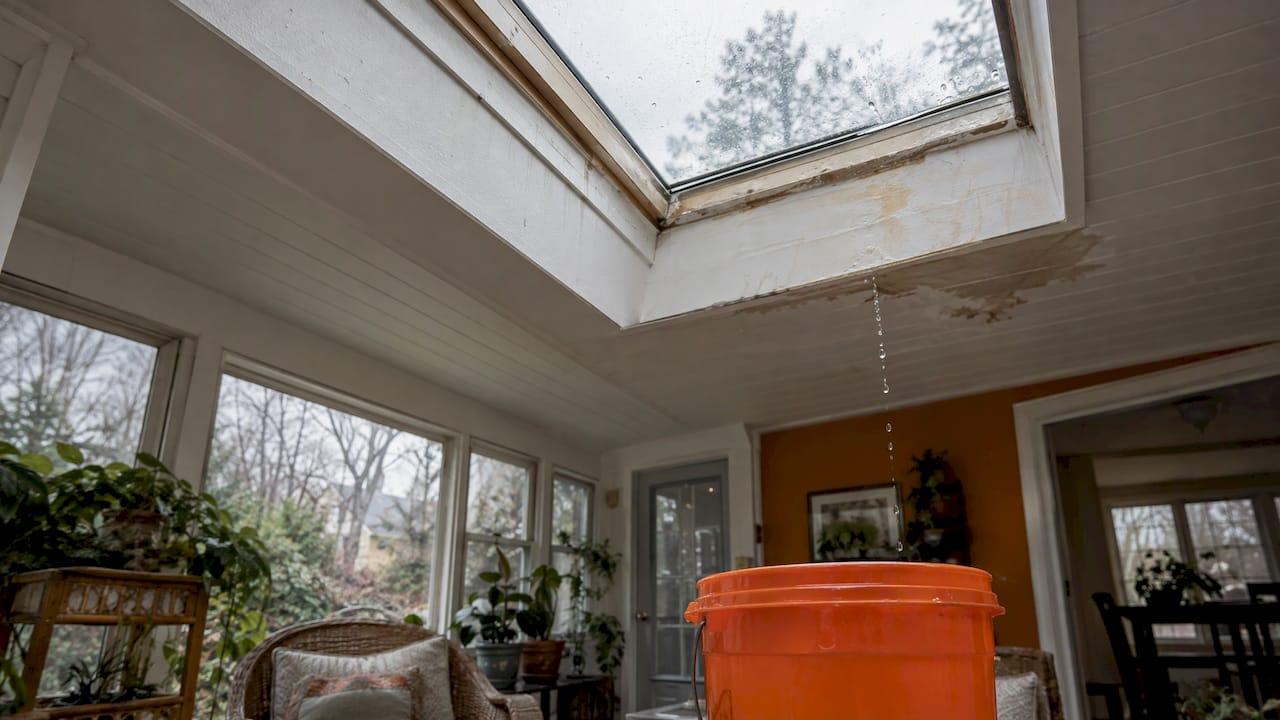
Skylight Leak Repair: Find the Source and Fix It Right

Most skylight leaks can be repaired, and the fix depends on where the water is actually getting in. Often the culprit is the flashing around the skylight or aged sealant, not the glass. Sometimes it is condensation that only looks like a leak. If the sealed glass unit has failed or the skylight is simply old, replacement is the durable answer. Below, we walk Maryland homeowners through diagnosing the problem, what to do tonight, what repair and replacement involve, and how to handle an insurance claim.
TL;DR
- Water that appears only during or after rain points to a leak. Evenly spread moisture on the room-side glass in cold weather usually points to condensation.
- Skylights are openings in the roof’s water-control layer, so the flashing and sealant around them are the usual weak points.
- Fogging between the panes means the sealed glass unit has failed, and replacement is the lasting fix.
- Stop the water now, document everything with photos, and do not leave a wet ceiling or attic insulation to dry on its own.
- Insurance generally responds to sudden, accidental damage, not to wear and deferred maintenance, so timing and records matter.
Table of Contents
- Is it a leak or condensation?
- What commonly causes a skylight to leak
- How to find the source
- What to do right now if it is leaking
- Repair or replace the skylight?
- What a proper repair involves
- What does skylight leak repair cost?
- Does homeowners insurance cover a leaking skylight?
- Preventing the next leak
- Our perspective
- Get your skylight leak looked at
- FAQ
- Sources
Is it a leak or condensation?
Before anyone climbs onto a roof, work out what kind of water you are dealing with. The American Society of Home Inspectors notes that most skylights leak eventually and that condensation problems often look just like leaks. Many skylights also have an interior tray around the perimeter that collects condensation, and that tray can overflow.
Here is how the two usually differ:
| Clue | Likely a leak | Likely condensation |
|---|---|---|
| When it appears | During or after rain or snowmelt | Cold weather, often mornings, with or without rain |
| Where | One spot, often a corner or the low side | Evenly across the glass |
| Staining | Brown rings on drywall or the light shaft | Little or none, maybe damp frame |
| Indoor humidity | Makes no difference | Worse in kitchens, baths, laundry rooms |
| Between the panes | Not related | Fog or droplets there mean a failed seal |
Warm, humid indoor air rises, meets cold glass and turns to water. Lowe’s guidance points out that bathrooms and laundry rooms are the usual offenders and that a fan or dehumidifier helps. If the drip stops when you run an exhaust fan or crack a window, you are looking at a moisture-in-the-air problem, not a hole in the roof.
One exception: moisture trapped between the panes is not a humidity problem. It means the insulated glass unit (IGU) has lost its seal, and wiping or defogging will not restore it.
What commonly causes a skylight to leak
The U.S. Department of Energy’s Building Science Education site explains that skylights are penetrations through the roof’s water control layer and a weak spot where water can reach the attic. In our experience in Baltimore County, the leaks trace back to a handful of causes.
Failed or dried-out flashing and sealant
Flashing is the layered metal that steps water around the skylight. At the head (the top edge), water has to be directed away from the unit, and at the sides and sill the pieces must lap correctly with the shingles. Sealant bridging gaps in that flashing dries, cracks and shrinks over time. Once it does, wind-driven rain gets behind it. When flashing was installed with too little overlap, or got bent out of position, water can slip under it even if the skylight itself is fine.

Gasket or seal failure in the skylight unit
Rubber gaskets and weatherstripping harden and shrink. On operable (opening) skylights, worn or missing gaskets let water through where the sash meets the frame. Leaks through joints in the frame itself are a sign the unit is reaching the end of its life.
Ice dams and snow
Maryland winters bring freeze and thaw cycles. When heat escaping from the attic melts snow on the upper roof, the water can refreeze lower down and back up under shingles and around a skylight. The skylight gets blamed, but the real fixes are attic insulation and ventilation, plus proper waterproof underlayment beneath the flashing. We cover related emergency steps in our guide on when to call for emergency roofing services.
Surrounding roof problems
A skylight curb sits in the middle of the roof. Worn shingles, lifted shingle edges or failed pipe boots uphill from it can send water down toward the skylight and make it look like the unit is leaking. This is why we look at the roof as a system, not just at the glass.
Age
Sealants and gaskets do not last as long as glazing, and glazing does not last as long as the curb. A skylight that is two decades old and leaking in several places is rarely worth patching one corner at a time.
How to find the source
The highest point where you see water staining on the ceiling, shaft or framing tells you the leak is above that point. Use that as your starting clue.
- Inspect from the inside. Look for peeling paint, stains, soft drywall and discolored framing around the light shaft. If you can get into the attic safely, check the rafters and sheathing around the skylight and look at the insulation for damp or compressed patches.
- Note the conditions. Write down whether the water appears in heavy rain, wind-driven rain, snowmelt or only after a long soak. Heavy rain from one direction often points to flashing on that side.
- Look at the roof from the ground. Binoculars help. Check for lifted or missing shingles near the skylight, bent or gapped metal and cracked, peeling sealant.
- Consider a water test. The Department of Energy’s guidance on inspecting skylights for water damage includes spraying the skylight and surrounding roof with a garden hose. The Building America Solution Center cautions that the test must not overwhelm the system beyond normal weather exposure: too much volume or velocity, or spraying upward at joints, can cause leaks that would never happen in real weather. That is why it is better left to someone experienced, not a weekend experiment from a ladder.
Safety note: roofs are slick when wet, and skylight glass or domes can break under weight. Never walk on or lean against a skylight, and stay off the roof during or just after rain, snow or ice.
What to do right now if it is leaking
- Contain the water. Put a bucket under the drip, lay towels or plastic sheeting and move furniture and electronics away. If the ceiling is bulging with trapped water, a small hole poked at the lowest point into a bucket can relieve it. If water is near light fixtures or outlets, stay clear and call an electrician or turn off power to that circuit at the panel.
- Photograph and film everything. Capture the skylight, the ceiling, the stains and any wet insulation. Date the photos. You will want them for any insurance claim.
- Dry the area. Wet insulation and drywall need attention fast. Our article on drywall water damage repair explains when to dry and patch and when to replace.
- Get a temporary cover if needed. A properly secured tarp or patch can hold until a dry day. See what works and what fails in our guide to a temporary roof patch. Roof-top tarping is a job for a crew with fall protection, not a homeowner on a wet slope.
Don’t wait on slow leaks. Even a small drip into attic insulation repeats with every storm, and wet insulation stops insulating while giving mold a place to start. Our overview of how emergency roofing prevents long-term water damage explains how quickly small leaks escalate.
Repair or replace the skylight?
The Department of Energy’s guidance on replacing existing skylights lists the situations where replacing beats repairing: the insulated glass unit has failed (condensation between the panes), there are leaks through joints in the frame, or gaskets and weatherstripping on operable units are missing, damaged or worn. It also notes that new skylights can offer better air tightness, energy efficiency and condensation resistance.
| What you find | Usual direction |
|---|---|
| Cracked sealant, small gaps in flashing | Repair: reseal or re-flash |
| Flashing bent, lapped wrong or rusted | Rebuild the flashing, often with new underlayment and shingles tied in |
| Leaks only in ice or snow conditions | Fix attic insulation, ventilation and underlayment, then check the flashing |
| Fog between panes | Replace the glass unit or skylight |
| Leaks at frame joints, worn gaskets, old unit | Replace the skylight |
| Roof around the skylight is near the end of its life | Often best to replace the skylight along with the roof |
That last row matters. If your shingles are 18 to 25 years old, re-flashing a skylight now and then reroofing in a year or two means paying for the same access twice. When we inspect, we will show you the evidence either way, so you can decide between a targeted roof repair and a full roof replacement without guessing.
What a proper repair involves
A durable fix goes beyond squeezing caulk around the glass. Clear silicone on a cracked edge is a quick stopgap that some homeowners use, but sealant alone does not address flashing that has failed or sits wrong. A solid repair usually means:
- Confirming the leak path first, so you are fixing the cause, not a symptom.
- Removing old, failed sealant and cleaning the joint so new material actually bonds.
- Resetting or replacing flashing so each piece laps over the one below it and sheds water, with waterproof underlayment (ice and water barrier) under the flashing where the roof is exposed to ice.
- Tying new shingles into existing ones around the curb so there are no exposed nail heads or gaps.
- Checking the sheathing and framing around the opening, and replacing any that stayed wet long enough to soften.
- Repairing the interior: insulation, drywall and paint once everything is dry.
If the water reached framing, we also handle the carpentry through our structural repairs work, and the interior finish through our painting crew, so you do not have to coordinate separate trades.
What does skylight leak repair cost?
The price depends on which cause is leaking: a reseal is the smallest job, a flashing rebuild is more involved, and a full skylight replacement is the largest. Roof pitch, access, shingle type, interior damage and whether the surrounding roof needs work all change the number. Because every skylight and roof is different, we don’t publish a flat price. We give an itemized estimate after an inspection, so you can see what each part of the work costs and why.
Be wary of any quote delivered over the phone without anyone seeing the roof, and of a price that covers only caulking when the flashing is clearly failing. A cheap patch that leaks again next month costs more than a correct repair.
Does homeowners insurance cover a leaking skylight?
Sometimes, but not always. The Insurance Information Institute explains that the standard HO-3 policy covers the dwelling on an open-perils basis, with listed exclusions, and that damage from poor maintenance is the homeowner’s responsibility. In practice, that means:
- A storm event such as a wind-driven rainstorm, fallen limb or hail strike that damages the skylight or its flashing is the type of sudden event insurers evaluate for coverage.
- Gradual deterioration, such as sealant that dried out over years or a leak that dripped for months, is generally treated as wear and maintenance and may be denied.
- Resulting water damage inside the home may be treated differently from the skylight itself, depending on your policy’s wording and the cause.
Your policy and your insurer decide coverage, so read the wording on wear and tear, water damage and roof-age limits, and ask your agent how your roof’s age affects payouts. Whatever the cause, protect your position:
- Report promptly and take dated photos and video before any cleanup.
- Make reasonable temporary repairs to prevent further damage, and keep receipts.
- Keep records of past roof maintenance and inspections.
- Ask the contractor to document the damage and be on the roof when the adjuster visits.
We do this routinely through our insurance restoration work: photographing damage, meeting the adjuster and carrying the restoration through.
Check your warranty

If your skylight is a newer branded unit, look up its warranty. For example, VELUX publishes its warranty terms, including a 10-year installation warranty, 20 years on glass seal failure and 10 years on the product. Whether your unit is covered depends on the brand, model and install date, so find the paperwork or the label on the unit.
Preventing the next leak
- Inspect once a year, and after major storms, from the ground and the attic. Look for stains, damp insulation and cracked sealant.
- Keep the area clear. Leaves and debris piled uphill of a skylight hold water against the flashing.
- Control humidity. Run bath and kitchen fans, and use a dehumidifier in damp rooms to reduce condensation that mimics a leak.
- Fix the attic. Good insulation and ventilation reduce ice dams that attack skylights in winter.
- Reflash during reroofing. New shingles are the best time to replace old flashing and underlayment around any skylight.
- Fix small things early. A cracked bead of sealant is a cheap fix. A soaked rafter is not.
Our perspective
Skylight leaks are one of the most misdiagnosed problems we see. Homeowners call about the glass, but when we get on the roof, the story is usually in the flashing, the shingle tie-ins or an older roof around the unit. That is why we start with an inspection and show you photos of what we find, instead of selling a fix before we know the cause.
We have worked in this trade for close to 31 years, and the pattern holds in Towson, Cockeysville, Perry Hall and Dundalk alike: the roof is a system. A skylight is a hole in that system, and every hole needs to be flashed and sealed correctly. When the flashing is the problem, we repair it properly. When the roof around it is near the end of its life, we tell you so, because doing that work once is better than paying for the same ladder and crew twice.
And because we also handle the drywall, insulation, framing and paint that a leak leaves behind, you deal with one licensed contractor from the first photo to the last coat of paint.
Charles Hinkel
Get your skylight leak looked at
Magnum Home Services is a Towson-based roofing and home services contractor serving Baltimore City, Baltimore County and nearby Harford and Anne Arundel communities. We are an Owens Corning Preferred Contractor, and our crews offer 24/7 storm response, emergency tarping and insurance restoration support.

If you have a drip, a stain or a skylight you no longer trust, start with our roof repair service for an inspection and an itemized estimate. If the water is coming in tonight, our emergency roofing and storm response team can tarp the area and document the damage for the claim. You can also see our recent roofing projects or read our guide on roof leak and ceiling repair to understand how we stop the source first.
FAQ
Can a leaking skylight be repaired?
Yes, in many cases. Failed sealant and flashing problems are often repairable without replacing the skylight. If the glass unit has fogged between the panes, leaks occur at frame joints or the unit is old and worn, replacement is usually the better long-term answer.
How do I know if my skylight is leaking or just condensation?
A leak shows up with rain or snowmelt, often at one spot, and leaves stains. Condensation appears in cold weather, spreads across the glass and improves when you ventilate the room. Moisture between the panes means the sealed unit has failed.
How long should I wait before calling a roofer?
Call as soon as you see water, especially if insulation or drywall is wet. Small leaks repeat with every storm, and damp materials can grow mold. Contain the water and photograph it in the meantime.
Will insurance pay for a skylight leak?
It depends on the cause and your policy. Sudden storm damage may be covered, while wear and deferred maintenance typically are not. Document the damage promptly, and ask your insurer how your roof’s age affects payouts.
Sources
- Skylights, American Society of Home Inspectors
- How to Repair a Leaky Skylight, Lowe’s
- Flashing around a Skylight with Roof Removal, Building Science Education (U.S. Department of Energy)
- Inspecting Skylights for Water Damage and Infiltration, Building Science Education
- Existing Skylights Repaired or Replaced and Fully Flashed, Building America Solution Center
- Replacing Existing Skylights, Building Science Education
- Which disasters are covered by homeowners insurance?, Insurance Information Institute
- VELUX Skylights Warranty
Recommended
Free, no-pressure inspections across Towson & Baltimore County.
Keep Reading
More from the blog


Free Estimate
Get your free, no-pressure roof estimate
Tell us what's going on and we'll call you within one business hour. Same-week appointments available across Baltimore County.
- BBB A+
- Owens Corning Preferred
- EPA Lead-Safe
- EIFS Certified
- Licensed & Bonded