
- BBB A+
- Owens Corning Preferred
- EPA Lead-Safe
- EIFS Certified
- Licensed & Bonded
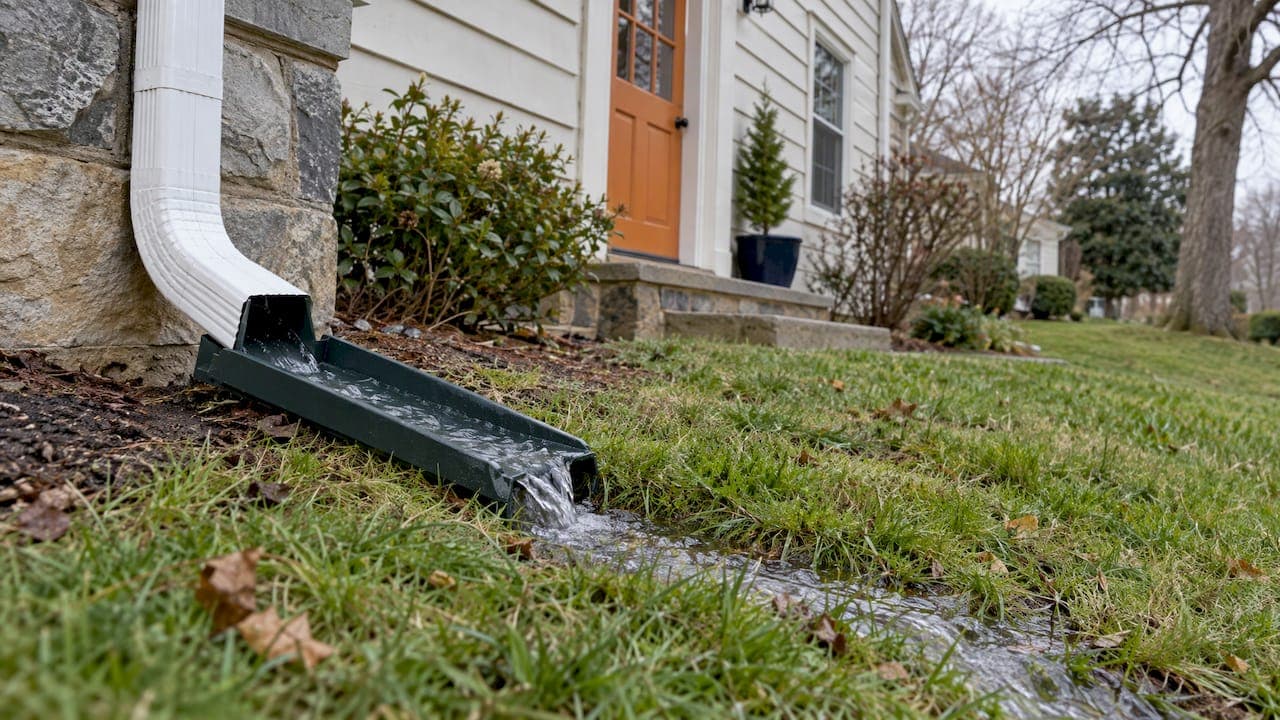
Downspout Drainage Solutions That Protect Your Foundation

The best downspout drainage solution is one that carries roof water well away from your foundation and releases it somewhere stable. For most Maryland homes that means a downspout extension or a buried solid PVC line that ends in the open at least 5 feet from the house, with the ground sloping away from the walls. A downspout should not feed a French drain or your foundation drain. Below, we cover each option, the numbers that matter, and how to tell which one fits your lot.
TL;DR
- Release roof water at least 5 feet from the foundation when it discharges above ground, or at least 10 feet away when it goes to an underground catchment, according to the Building America Solution Center.
- Buried downspout lines work best in solid PVC. Corrugated pipe can clog and let roots in, per Prince George’s County’s homeowner drainage guide.
- Do not connect a downspout to a French drain or to the perforated drain around your foundation. Roof runoff is too concentrated and can saturate the soil next to the walls.
- If clean gutters still spill over in heavy rain, the system may be undersized or the downspouts too few.
- A wet basement or soggy yard after rain is often a downspout problem first and a waterproofing problem second.
Table of Contents
- Why downspouts matter more than most homeowners think
- The main downspout drainage options
- Should you bury your downspouts?
- Can a downspout connect to a French drain?
- Direct water away from the foundation: the numbers
- Why downspouts overflow in heavy rain
- Extending downspouts and understanding roof runoff
- Our perspective
- Get the whole water path checked
- Check the site before you dig
- Keep it working: maintenance
- Choosing the right solution for your lot
- FAQ
- Sources
Why downspouts matter more than most homeowners think
A roof collects a surprising volume of water and funnels it to a few points. Every downspout is a concentrated stream, and where it lands decides whether that water soaks into the soil beside your footing or travels safely away. When the stream lands at the base of the wall, the soil there stays saturated, pressure builds against the foundation, and the water finds its way through cracks, window wells and the cove joint where the floor meets the wall.
We see this pattern on Baltimore County homes constantly. A homeowner calls about a damp basement, and the first thing we check is what the downspouts are doing on that side of the house. If you are already dealing with water inside, our guide to a wet basement after rain walks through causes and first steps.
The main downspout drainage options
The Building America Solution Center lists several approved ways to manage roof runoff: ending the gutter outlet at least 5 feet from the foundation, discharging to an underground catchment at least 10 feet away, harvesting rainwater with a managed overflow, or building a lined grade-level rock bed whose drain pipe runs to a sloping grade at least 5 feet away, a drywell or another approved location.
Here is how those translate into everyday choices.
| Option | Best for | Main watch-out |
|---|---|---|
| Hinged or rigid downspout extension | Flat or gently sloping yards with room to run water out | Trip hazard, mowing, and must be moved or lifted |
| Splash block | Nothing more than a temporary stopgap | Releases water too close to the house |
| Buried solid PVC line to daylight | Lots with enough slope to carry water out to a lower point | Needs steady pitch and a cleanout; outlet must be stable |
| Underground catchment or drywell | Flat lots with no lower outlet | Needs soil that drains and a spot at least 10 feet from the house |
| Rock bed or rain garden at grade | Landscaped beds, small volumes | Must be lined near the foundation and sized for the roof area |
| Rain barrel or cistern with overflow | Gardens, reducing runoff volume | Overflow still has to go somewhere safe |
Extensions and why splash blocks fall short
The simplest fix is a downspout extension that carries water out to the required distance. NC State Extension prefers downspouts connected to drainpipes over splash blocks, because a splash block lets water out too near the foundation. If you have a splash block today and the soil beside it is eroded or stays wet, that is your cue to upgrade.
Extensions come in rigid, flexible and hinged versions. Hinged ones flip up for mowing, which makes them more likely to be used. Whatever you choose, make sure the water ends on ground that slopes away from the house, not in a depression that leads back toward it.
Rock beds and rain gardens
A lined rock bed at grade can take the force out of a downspout and spread the water out. The Building America Solution Center describes it as a grade-level rock bed with a drain pipe that leads to a sloping grade, a drywell or another approved location. The liner matters near the house: without it, you are just soaking the soil beside the footing with a prettier surface.

Rain barrels and harvesting
Collecting water in a barrel or cistern reduces the volume that reaches the ground, and it is a legitimate option when it includes managed overflow. The overflow is the part people forget. In a long storm the barrel fills in minutes, and the overflow hose needs the same distance and slope as any other downspout outlet.
Should you bury your downspouts?
Burying the line is often the cleanest answer when you need to move water 10 feet or more across a yard. It keeps the lawn mowable, removes the trip hazard and lets you send water to a lower corner of the lot. It is not automatically better, though. A buried line that is poorly pitched, crushed, or terminates in a spot that stays wet can create more problems than a surface extension.
PVC versus corrugated pipe
Prince George’s County’s drainage guide says homeowners can bury downspout extensions using PVC and should avoid corrugated pipe, which can clog from material buildup and may allow root intrusion. A smooth-walled pipe sheds silt and can be cleared with a hose or a drain snake. Corrugated ribs trap sediment and are harder to clean.
The Building America Solution Center specifies that lateral piping ideally uses non-perforated flexible ABS or Schedule 40 PVC, pitched at a minimum of 5/8 inch per foot, or about 5 percent, away from the foundation. Note the word non-perforated: a downspout line is meant to carry water to the outlet, not leak it along the way.
NC State Extension also notes that underground pipes may be clay tile or flexible pipe to conduct water to an outlet at least 10 feet from the home. Different agencies allow different materials, but all agree on the destination. If you want the easiest line to maintain, solid PVC with cleanouts is the choice we would make.
A simple layout that works
- Connect each downspout to a catch fitting or solid adapter at the base, with a removable debris screen or a cleanout nearby.
- Dig a trench that falls at least 5/8 inch per foot from the house outward.
- Lay solid PVC, glue the joints, and keep bends gradual rather than sharp 90 degree turns.
- Run it to an outlet in the open, such as a pop-up emitter or a daylight discharge on a lower part of the lot, at least 5 feet from the foundation and well away from neighboring property.
- Test with a hose before you backfill, and mark the cleanout locations.
The outlet is where jobs go wrong. Ask Extension makes the point that redirecting runoff only works if it ends at a stable outlet; otherwise the problem simply moves downhill or onto a neighbor’s property.
Can a downspout connect to a French drain?
This is the most common question we hear, and the answer is no. A French drain is a gravel-filled trench with perforated pipe designed to intercept groundwater or ponded water. Prince George’s County’s guidance says it should not be the primary conduit for concentrated roof runoff, and that tying gutter downspouts into foundation or perforated drains can cause foundation saturation.

The same principle applies to the perforated drain around your footing. The Building America Solution Center, citing EPA Indoor airPLUS guidance, says downspout discharge must stay separate from the home’s perforated foundation drain system, since connecting them can soak the foundation.
Think of it this way. A perforated pipe is built to let water in and out along its length. During a downpour, a downspout can push far more water into it than the surrounding soil can accept. The pipe leaks the excess right where you do not want it, beside the house.
If the downspout needs to reach a French drain system on your lot, the right method is a solid, non-perforated pipe that carries the water past the drain and out to daylight or a proper outlet. If you are weighing how to handle both roof water and groundwater, the right setup is usually two separate systems: solid pipe for the roof, and interior or exterior drain tile for groundwater. Our waterproofing work in Towson and Baltimore County follows that separation.
Direct water away from the foundation: the numbers
Two measurements do most of the work: distance and slope.
- Distance. Discharge to daylight at least 5 feet from the foundation, or to an underground catchment at least 10 feet away, according to the Building America Solution Center. The same page lists a storm sewer or other approved discharge point as acceptable where available.
- Surface slope. The Building America Solution Center calls for a slope of at least 0.5 inch per foot for at least 10 feet away from the house. Prince George’s County and the Northern Virginia Soil and Water Conservation District recommend a 5 percent slope for the first ten feet.
- Pipe slope. At least 5/8 inch per foot for buried lateral piping.
A 5 percent grade is about 6 inches of drop over 10 feet. If you stand at the foundation and your soil does not fall by at least that much, you may need to regrade, add fill or build a shallow swale. Do not let mulch beds, edging or flower borders trap water against the wall.
Why downspouts overflow in heavy rain
If water pours over the top of your gutter or out at the corners, the cause is almost always one of two things. The Prince George’s County guide says overflow happens when gutters are blocked by debris or undersized.
Look for these signs:
- Water streaks or marks on siding below the gutter line
- Erosion or a trench along the drip line
- Spillover during ordinary rain, not only cloudbursts
- Wet or stained soffit and fascia, which can point to water backing up at the roof edge
Clean the gutters and downspouts first. If they still spill over, the system may be undersized for the roof area, or a long roof run may be sending all its water to a single downspout. Adding a downspout, upgrading to a larger gutter profile or both is usually the fix. Clogged elbows are another culprit, so check them with a hose from the top.
Water that backs up can also rot the roof edge. If you see peeling paint or soft wood under the gutter, read our guide on soffit and fascia repair to decide what you can handle and what needs a contractor.
Extending downspouts and understanding roof runoff
How the roof itself sheds water affects what your downspouts must handle. If you are curious about how treatments and surfaces influence what comes off the shingles, this explainer on roof runoff and rainwater pairs well with the extension options above.
Our perspective
Most of the foundation and basement calls we take in Baltimore County start on the roof edge, not in the basement. A downspout dumping at the corner of a house can undo thousands of dollars of waterproofing, and a clean, well-pitched PVC line costs a fraction of that.
Our rule is simple: roof water and groundwater never share a pipe. We run solid pipe from the gutter to a proper outlet, and we keep drain tile for groundwater. Because we handle the gutters, the roof, the concrete and the waterproofing under one roof, we can check the whole path from the shingles to the soil instead of fixing one link and leaving the next one failing.
If you are not sure whether your problem is the gutters, the grade or the foundation, ask someone to show you the evidence on your own property. That is how we run every inspection.
Charles Hinkel
Get the whole water path checked
If your downspouts are overflowing, your gutters pull away from the house, or the soil beside the foundation stays wet, we can look at the full system, from roof edge to discharge point. Magnum Home Services handles gutters and exterior work, waterproofing and roof repair in Towson and across Baltimore County, so you do not have to coordinate separate crews.

Want to talk through your property? Contact Magnum Home Services for an inspection that shows you what is happening and why.
Check the site before you dig
Before you change where water goes, think about where it will end up. The EPA advises homeowners to consider local regulations and where redirected water will flow, so it does not cause property damage or unsafe conditions. In practice:
- Do not aim a discharge at a neighbor’s yard, a driveway that ices over in winter, or a retaining wall.
- Keep outlets away from septic fields and from the sides of slopes that are already eroding.
- Call 811 before digging any trench so buried utilities are marked.
- Ask your county or city permit office whether grading or drainage changes need approval, especially on shared property lines or in a community with an HOA.
If your roof runoff is already causing problems with the neighbors or the street, a contractor can help design a compliant discharge. For storm-related gutter and roof damage, our page on storm and wind damage repair explains how we respond.
Keep it working: maintenance
Even the best layout fails if it clogs. NC State Extension says to inspect the gutter system yearly and after major weather events, making sure downspouts and elbows stay clear of debris. Prince George’s County recommends removing debris at least once a year and notes that gutter guards or leaf screens can cut down how often you need to clean.
A practical routine for a Maryland home with mature trees:
- Clean gutters in late fall after the leaves drop, and again in spring if you have pines or maples shedding seeds.
- Flush each downspout with a hose and confirm water exits the outlet.
- Walk the property in a rainstorm at least once a year and watch where the water goes.
- Check buried lines by running a hose at the top and watching the outlet for a steady flow.
- Look for splash erosion, low spots and mulch dams along the foundation.
Gutters damaged by hail or high wind often show it first at the seams and downspout connections. Our write-up on checking gutters before filing a hail claim explains what to document if an insurance claim is on the table.
Choosing the right solution for your lot
Start with the slope of your yard.
- Yard slopes away from the house. A hinged or rigid extension to 5 feet or more often does the job. Move up to buried PVC if you want it out of sight.
- Yard is flat. A buried line to a pop-up emitter at the edge, or an underground catchment at least 10 feet out, is usually the better option.
- Yard slopes toward the house. Fix the grade first. No extension will save a foundation if the surface drains back to it. A swale or regrading may be needed.
- Water pools or the basement leaks despite good downspouts. Groundwater may be the issue. That is a job for interior or exterior drain tile and a sump, which is a different system.
- Roof edge is rotting or gutters sag. Repair that before you extend anything.
If your roof is 10 to 20 years old and water is landing near the foundation, it is also worth having the roof and gutters looked at together. Many leaks that show up as stains on a ceiling have a link to what is happening at the edge. See our guide to stopping a roof leak at its source.
FAQ
What is the best downspout drainage option?
For most homes, a solid PVC line that runs underground to an open outlet at least 5 feet from the foundation is the most durable and tidy answer. A simple extension is a good low-cost first step on a yard that already slopes away from the house. The right choice depends on your grade and where you can safely release the water.
Should I bury my downspouts or leave them above ground?
Bury them if you need to move water more than a few feet, want a clean lawn or have somewhere lower to send it. Use solid PVC rather than corrugated pipe, pitch it at least 5/8 inch per foot and add a cleanout. Leave them above ground when the yard already slopes well and a hinged extension reaches far enough.
Can I connect my downspout to a French drain?
No. French drains use perforated pipe to collect groundwater, and roof runoff arrives in a concentrated rush that can overload them and saturate the soil beside the foundation. Use solid pipe for roof water and send it to daylight or an approved outlet.
Why do my downspouts overflow in heavy rain?
The usual causes are clogged gutters or gutters that are undersized for the roof. Clean them and the downspout elbows, then watch a storm. If water still spills over, you may need larger gutters or more downspouts.
Sources
- Gutters and Downspouts, Building America Solution Center
- A Homeowner’s Guide to Drainage Problems and Solutions, Prince George’s County
- Moisture Control and Prevention: Gutter Management, NC State Extension
- Water drainage from rain downspout, Ask Extension
- Soak Up the Rain: Disconnect / Redirect Downspouts, US EPA
- Roof Treatment and Rainwater
Recommended
Free, no-pressure inspections across Towson & Baltimore County.
Keep Reading
More from the blog


Free Estimate
Get your free, no-pressure roof estimate
Tell us what's going on and we'll call you within one business hour. Same-week appointments available across Baltimore County.
- BBB A+
- Owens Corning Preferred
- EPA Lead-Safe
- EIFS Certified
- Licensed & Bonded