
- BBB A+
- Owens Corning Preferred
- EPA Lead-Safe
- EIFS Certified
- Licensed & Bonded
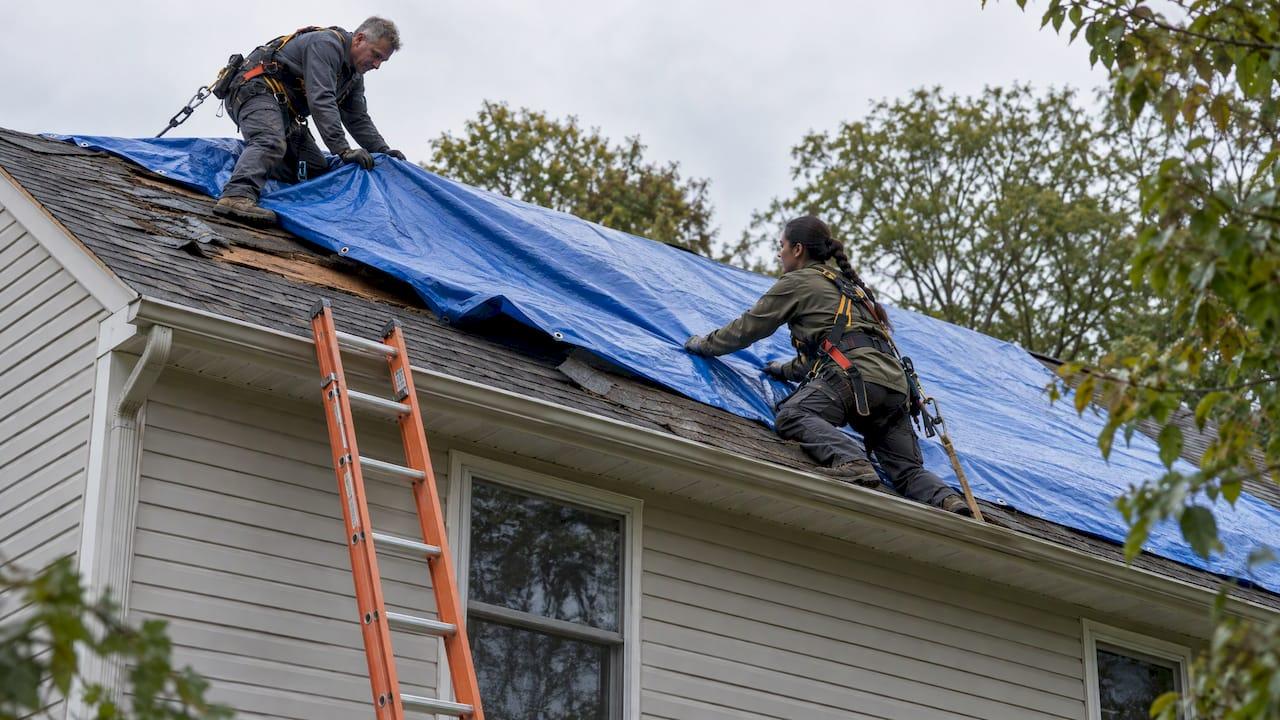
Emergency Roof Tarping: What to Do Tonight and Next

If a storm has opened your roof, the goal tonight is simple: keep water out until a permanent repair can be made. A properly anchored tarp does that. Done wrong, it blows off in the next gust or damages the shingles you were trying to save. For Towson and Baltimore County homeowners, the safest route is a crew that tarps the roof the same day and documents the damage for your insurer. Magnum Home Services offers 24/7 storm response and emergency tarping, and the permanent repair and insurance restoration are handled by the same company. Below is how tarping works, what it costs, and what to do before and after it so your claim is protected.
TL;DR
- Emergency tarping is a temporary cover over storm damage. It stops water from reaching insulation, drywall and framing until the roof is repaired.
- Photograph the damage first, then tarp. Keep every receipt, and do not authorize permanent repairs until your insurer has seen the damage.
- A damaged, wet or steep roof is dangerous to walk on. Federal safety guidance says a damaged roof’s strength must be assessed before anyone goes up.
- Published cost guides put most standard tarp jobs in the low hundreds of dollars, with after-hours work costing noticeably more.
- A tarp is a stopgap. Plan the permanent repair or replacement right away.
Table of Contents
- When a roof needs an emergency tarp
- The first hour: safety and documentation
- Should you tarp the roof yourself?
- How a roof is tarped correctly
- Where tarps fail
- What emergency roof tarping costs
- Tarping and your insurance claim
- After the tarp: repair or replace?
- Emergency tarping from Magnum Home Services
- Our perspective on emergency tarping
- FAQ
- Sources
When a roof needs an emergency tarp
Not every leak is an emergency, but an open roof is. Call for tarping when any of these happen:
- Wind has torn off shingles or a section of decking is exposed.
- A tree limb or debris has punctured the roof.
- Water is coming through a ceiling during or just after a storm.
- Hail or high wind has left a large area of missing or lifted shingles.
Water that gets into an attic keeps working after the rain stops. It soaks insulation, stains and loosens drywall, and feeds mold. That is why the tarp matters more than its price suggests. Our guide on when to call for emergency roofing services goes through the warning signs in more detail, and the effect of waiting is covered in how emergency roofing prevents long-term water damage.
Maryland roofs take a lot of this. Thunderstorms, nor’easters and high wind all hit Baltimore County, and homes near the water in Dundalk, Essex and Middle River get the harshest exposure. A roof that is 10 to 20 years old is the most likely to lose shingles in a gust, because the sealant strips that hold them down weaken with age.
The first hour: safety and documentation
Before anyone thinks about a tarp, do two things.
1. Check for hazards. The Better Business Bureau advises homeowners to check for injuries and hazards first, then assess the damage. Stay out of rooms with sagging ceilings. If you see water near light fixtures or outlets, stay clear and call an electrician or your utility.
2. Photograph everything. The North Carolina Department of Insurance tells homeowners to list the damage and take clear pictures before temporary repairs. Practices are similar in Maryland, and your insurer will ask for the same evidence. Take wide shots of each elevation, close-ups of missing shingles and punctures, and photos of interior ceilings and walls. Add a short video of any active drip. Do this from the ground or from inside your home, not from the roof.

If you call us, tell us what you have already photographed. We document the damage as part of storm and insurance work, which gives you a record that holds up when the adjuster arrives.
Should you tarp the roof yourself?
This is the question behind most searches for how to tarp a roof after a storm, and the honest answer is that the roof, not the tarp, is the hard part.
OSHA’s roof tarping safety publication says workers must not access a damaged roof until its strength and structural integrity have been determined. Storm damage can hide rotted or broken decking that looks solid and gives way underfoot. A wet roof adds slipping risk, and a steep pitch adds fall risk.
The Department of Energy’s Pacific Northwest National Laboratory, in its guidance on tarping after floods and storms, says to arrange professional installation if possible. If you do it yourself, it says to work with a partner, wait until it is dry, and use a full-body harness on steep slopes. That is a lot of conditions to meet at night, in the wind, with water already coming in.
Most homeowners are better off leaving the roof to a crew with fall protection, the right fasteners and the experience to read the decking. That is the work our emergency tarping team does.

How a roof is tarped correctly
The method below is the one published by building-industry and home-improvement sources. It also shows why a professional job lasts longer than a hurried one. At each step we note where it goes wrong and what we take off your hands.
- Assess the roof before stepping on it. The crew checks for soft decking, loose shingles and a safe access route. This is the step the homeowner usually skips. Our crews do the assessment, and the same people can write up the damage afterward.
- Measure the damage and size the tarp generously. IKO’s guide says the tarp should be larger than the measured damage and long enough to hang over the ridge so water rolls off smoothly. Bob Vila’s guide suggests extending it about 4 feet over the peak. A tarp that stops at the damage lets water run under its upper edge.
- Cover open holes first when needed. This Old House recommends that for longer-term protection, a hole should first be covered with 5/8-inch exterior-grade plywood screwed to undamaged sheathing before the tarp goes on. Sheathing is the wood deck under the shingles.
- Lay the tarp up and over the ridge. The upper edge goes over the peak and down the other side, so the seam is not where water collects. Use a heavy-duty, outdoor-rated tarp, not a thin hardware-store sheet.
- Anchor with boards, not just nails. Bob Vila’s guide says to wrap the tarp fully around a 2x4 so nails cannot tear through in heavy wind. IKO adds that boards should not sit perfectly level: one end should be lower so water drains off that side.
- Secure all edges and check for pooling. Fasteners must reach solid wood. Any slack where water can pool will flap in the wind and wear through the tarp.
- Record the finished job. Photograph the tarp in place and keep the invoice. This is the part that protects your claim.
One detail every source agrees on: fasteners driven through shingles leave holes. IKO notes the shingles under fasteners will need replacement during the permanent repair. That is one more reason to plan the repair soon, rather than leaving a tarp up for the season.
Where tarps fail
Most failed tarps share the same few mistakes:
- Too small. Edges that barely clear the damage let wind-driven rain in.
- Nailed straight through the tarp. The fabric tears at the nail in the first strong gust.
- No ridge overlap. Water finds the upper edge and runs underneath.
- Light plastic sheeting. UV and wind break it down quickly.
- Left in place too long. A tarp covers the problem for days or weeks. It does not repair it.
If you want to understand what temporary measures can and cannot do, our article on temporary roof patches: what works, what fails, and when to call covers it.
What emergency roof tarping costs
We do not publish a tarping price, because it depends on the roof. What you can do is understand what moves the number.
A published cost guide based on HomeGuide data, updated in December 2025, reports that most homeowners pay roughly $175 to $700 for a standard daytime tarp job, with a national average of about $450. It puts emergency or after-hours work higher, at roughly $1.00 to $2.80 per square foot against $0.70 to $2.00 for standard work, sometimes with a call-out fee. Those are national averages, published for 2025 and 2026, and local bids will differ.
The same guide explains why even a small patch costs hundreds of dollars: the tarp material is only a small fraction of the price, and the rest is labor, anchoring and dispatch. Four things drive your bill:
- Size of the damaged area. A bigger opening needs a bigger tarp and more boards.
- Roof pitch and height. Steep or multi-story roofs take more safety equipment and time.
- Access. Tight lots, trees and attached structures slow the work.
- Timing. Night, weekend and post-storm demand, when every crew in the region is busy, cost more.
Bear in mind what the tarp prevents. Water that reaches insulation and drywall leads to a separate repair and sometimes mold remediation. Our water damage restoration team handles that work when a leak has already gone through.
Tarping and your insurance claim
A tarp is often the first expense of a storm claim, and how you handle it affects the rest. Insurance regulators say the same thing in several states:
- Make the temporary repairs needed to prevent further loss and keep every receipt. The NAIC claims disaster guide, reproduced by the Colorado Division of Insurance, tells homeowners to keep all receipts for emergency repairs and give them to the insurer.
- Report the loss to your insurer promptly. The North Carolina Department of Insurance notes that reasonable expenses to protect the property are part of the loss and may be reimbursed.
- Hold off on permanent repairs until the insurer has inspected. The same NAIC guide warns that the company may not pay for repairs it did not authorize.
These pages come from other states, so check your own policy and your insurer’s instructions for Maryland specifics. Your insurer and the Maryland Insurance Administration are the authorities on what your policy covers.
What we do is the practical side. Magnum photographs and documents storm damage, and our insurance restoration work includes meeting the adjuster on the roof and carrying the restoration through. Details are on our storm damage roof repair and insurance restoration page.
After the tarp: repair or replace?
The tarp buys time, and you should use it to get an honest inspection. Two questions decide the next step:
- How much of the roof is damaged? A localized puncture or a few lost shingles usually points to repair. Widespread granule loss, curling or repeated leaks on a 15 to 20 year old roof can point to replacement.
- What is under the shingles? Wet decking and insulation may need to be replaced whichever route you choose.
A good inspection shows you the evidence: photos of the damage, the condition of the decking and a written scope. We provide itemized estimates, so you can compare roof repair and roof replacement on the same facts. If you are an Owens Corning shingle fan, we are an Owens Corning Preferred Contractor.
If you manage a rental property, the principles of preparing for storms, and acting fast after one, are the same. This guide on protecting property from weather damage is a useful companion for landlords.
Emergency tarping from Magnum Home Services
Magnum Home Services is a roofing and home services contractor based in Towson, serving Baltimore City, Baltimore County and nearby Harford and Anne Arundel County communities. We provide emergency tarping around the clock, and the same company handles storm and wind damage repair, insurance restoration, roof repair and replacement. Our crews are in-house, so the people who secure your roof tonight are part of the company that carries the repair through. We hold a 5.0 Google rating from 102 reviews.

If your roof is open right now, start with our emergency tarping page, or see our full storm, insurance and tarping services.
Our perspective on emergency tarping
After close to 31 years in this trade, I can tell you the tarp is the most important and least glamorous part of a storm repair. It decides whether you have a roof problem or a roof, ceiling, insulation and flooring problem.
We built Magnum around a simple idea: the same company that stops the water should be able to fix what caused it. A tarp that is put up well, photographed and written up gives you a clean start on the insurance claim, and it lets us move into the permanent repair without starting from scratch.
Because we handle roofing, water damage restoration, structural repairs and other trades under one roof, we can follow the damage wherever it goes, from the shingles to the framing to the drywall. That is how homeowners avoid chasing several contractors in the worst week of their year.
Charles Hinkel
FAQ
How long can a roof tarp stay on?
A tarp is designed as a short-term measure. Sources describe it as a stopgap until permanent repairs, and fasteners through shingles mean those shingles will need replacement. Schedule your inspection and repair as soon as your insurer has seen the damage.
Can I tarp a roof in the rain?
It is a bad idea. The Department of Energy’s guidance says to wait until it is dry before going up. Wet shingles and decking are slippery. If water is coming in during a storm, contain it inside with buckets and call an emergency crew for tarping once conditions allow.
Will insurance pay for emergency tarping?
Often the reasonable cost of protecting the property from further damage is treated as part of the loss, but it depends on your policy. Keep receipts, take photos before and after, and report the claim to your insurer promptly. Your insurer can confirm what your policy covers.
Do I need a tarp if the damage is small?
Any opening that lets water in should be covered, even if it looks small. Water travels along rafters and shows up feet from the entry point. A quick inspection tells you whether a tarp or a direct repair is the better first step.
Sources
- Roof Tarping (Blue Roof) Safety, OSHA
- Flooded Homes: Installing Roof, Window, and Door Tarps, PNNL
- How to Tarp a Roof, IKO North America
- How to Tarp a Roof During Repairs, Bob Vila
- Emergency Roof Protection, This Old House
- Cost to Tarp a Roof in 2026, The Roofing Brief
- How To Deal With The Aftermath of a Disaster, NC Department of Insurance
- NAIC Claims Disaster Guide, Colorado Division of Insurance
- BBB Tip: What to do after a damaging storm
- How to Protect Your Rental Property from Weather Damage
Recommended
Free, no-pressure inspections across Towson & Baltimore County.
Keep Reading
More from the blog
Free Estimate
Get your free, no-pressure roof estimate
Tell us what's going on and we'll call you within one business hour. Same-week appointments available across Baltimore County.
- BBB A+
- Owens Corning Preferred
- EPA Lead-Safe
- EIFS Certified
- Licensed & Bonded